Industrial In-House Tooling Cleaning
EIG Series | Industrial Burn-Off Oven | EIG-52
Heavy-Duty Capacity. Flexible Industrial Applications – Designed for larger tooling, heavier components, and substantial production loads across injection molding, extrusion, fiber, coating, and industrial maintenance operations.
Bring demanding thermal-cleaning applications in-house with an industrial burn-off oven series configured around your tooling, residue volume, production throughput, and material-handling requirements.
Speak With a System Specialist
Call +1 (908) 229-6335
Industrial Burn-Off Ovens Built for Large Injection Molding & Extrusion Tooling
The EIG Series uses controlled heat to decompose polymer, resin, paint, powder coating, varnish, oil, grease, and other combustible organic residue on compatible metal tooling and production components. The main burner flame remains outside the work area, allowing the load to be processed through controlled heat rather than direct flame contact. After the cycle and required cooldown period, the remaining ash is removed through an application-appropriate finishing process.
Made for Larger, Heavier Tooling
Select the appropriate EIG configuration based on chamber dimensions, load weight, organic content, cleaning frequency, required throughput, utilities, and material-handling needs.

*3D System Model

Built for Real Load Requirements
Process substantial hot runner components, assembled dies, spin packs, coating fixtures, industrial racks, and other sizeable production loads.
Industrial In-House Cleaning for Large-Scale Injection Molding & Extrusion Operations
The EIG Series is a large burn-off oven that gives manufacturers a controlled in-house process for cleaning larger tooling and recurring production loads that may be impractical to handle through extensive scraping, manual burning, or repeated outsourced processing.
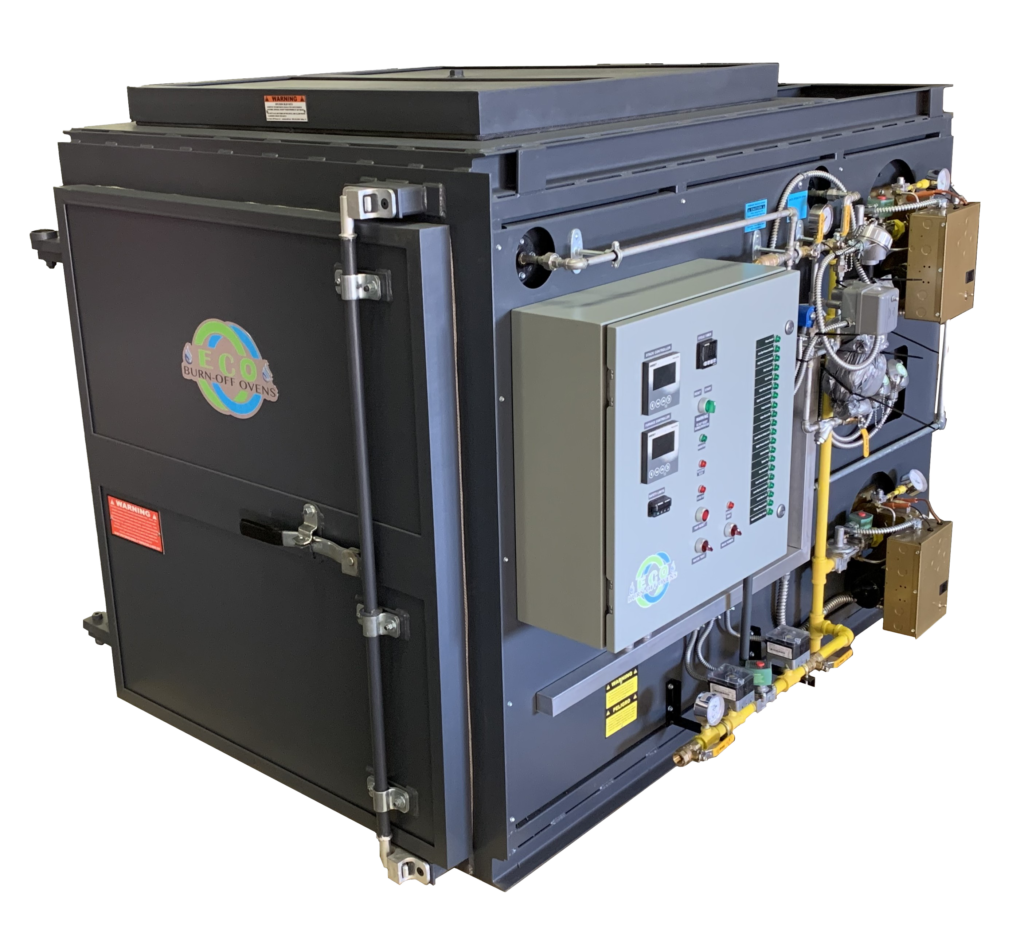
The featured EIG-52 heavy duty burn-off oven is positioned for substantial applications such as large hot halves, compatible assembled blown-film dies, fiber spin packs, tooling plates, coating fixtures, and other heavy industrial components.
Injection Molding Applications
Clean compatible hot halves, molds, tooling plates, and large metal components
Break down degraded resin and polymer residue before inspection or maintenance
Accommodate substantial tooling loads selected around verified chamber and weight limits
Extrusion Die Applications
Process blown-film dies, extrusion tooling, breaker plates, and screen packs
Clean compatible spin packs and metal tooling used in synthetic-fiber production
Reduce polymer buildup across larger, heavier, and more complex production components
*Because EIG systems are available in multiple size configurations, the correct oven should be selected around the dimensions of the largest component, typical complete load size, maximum load weight, organic material volume, cleaning frequency, available utilities, loading method, and future production requirements.
FAQ: EIG Series (EIG-52)
Heavy-Industrial Capacity
Large Tooling Applications
Automated Process
Learn more about controlled thermal cleaning for large hot runner tooling, blown-film dies, extrusion components, spin packs, coating fixtures, and substantial industrial production loads.
The EIG Series is designed for larger, heavier tooling and substantial industrial production loads affected by combustible organic residue. Potential applications include hot halves, molds, tooling plates, blown-film dies, extrusion components, spin packs, coating fixtures, motor components, automotive parts, industrial racks, and compatible machinery components.
Some hot runner assemblies and assembled dies may be candidates for thermal cleaning, but suitability must be established before processing. Heaters, wiring, thermocouples, seals, electronics, brazed components, coatings, and other temperature-sensitive materials require careful review. Partial or complete disassembly may be required depending on the tooling construction and allowable processing temperature.
Cycle duration depends on the mass and arrangement of the load, the amount and type of organic residue, selected operating conditions, and required cooldown time. Cleaning time should therefore be evaluated for the actual application rather than represented by one fixed cycle length.
No. The main burner flame remains outside the work area. The components inside the chamber are exposed to controlled heat rather than direct flame contact while combustible organic material decomposes under programmed, oxygen-limited conditions.
Industrial Capacity, No Outsourced Delays.
Process large, recurring tooling loads around your maintenance schedules, changeovers, and production priorities.